
Tag Archives: ISO 9001:2015 consulting
TRAINING PLAN AND TRAINING REALIZATION – TRAINING NEED ANALYSIS,
 Introduction
The Quality management principles underlying the ISO 9000 family of standards (of which the ISO 10000 series form a part) emphasize the importance of human resource management and the need for appropriate training. They recognize that customers are likely to both respect and value an organization’s commitment to its human resources and its ability to demonstrate the strategy used to improve the competence of its personnel.
Personnel at all levels should be trained to meet the organization’s commitment to supply products of a required quality in a rapidly changing market place where customer requirements and expectations are increasing continuously.
This International Standard provides guidelines to assist organizations and their personnel when addressing issues related to training. It may be applied whenever guidance is required to interpret references to “education“ and “training“ within the ISO 9000 family of quality assurance and quality management standards. Any references to “training“ in this document includes all types of education and training.
An organization’s objectives for continual improvement, including the performance of its personnel, might be affected by a number of internal and external factors including changes in markets, technology, innovation, and the requirements of customers and other stakeholders. Such changes may require an organization to analyse its competence-related needs. Figure 1 illustrates how training could be selected as an effective means of addressing these needs.
Training Need Analysis, Training Plan and Training Realization
Training can be described as “the acquisition of skills, concepts or attitudes that result in improved performance within the job environment”.
“Training is process to provide and develop knowledge, skills and behaviours to meet requirements” (ISO 10015 Clause 3.2)
Training analysis looks at each aspect of an operational domain so that the initial skills, concepts and attitudes of the human elements of a system can be effectively identified and appropriate training can be specified.
Training analysis as a process often covers:
- Training Analysis is most often used as part of the system development process. Due to the close tie between the design of the system and the training required, in most cases it runs alongside the development to capture the training requirements
Training Analysis (sometimes called Training Needs Analysis (TNA)) is the process of identifying the a gap in employee training and related training needs.
Training Needs Analysis (TNA) is defined as the “Identification of training requirements and the most cost effective means of meeting those requirements”.
A TNA should always be performed where a major new development in policy, equipment acquisition or procedures is deemed to have potential impact upon the current training regime.
What is ISO 10015?
The ISO 10015 Quality Standard for Training is a sector specific quality assurance system. It focuses on training processes at the workplace.
ISO 10015 complements ISO 9001 Standard and further elaborates on the clause 6.2.2 — “Awareness, Competence and Training” and gives clear guidance for its implementation.
The role of this ISO 10015 International Standard is
- to provide guidance that can help an organization to identify and analyse training needs,
- design and plan the training,
- provide for the training,
- evaluate training outcomes,
- and monitor and improve the training process
in order to achieve its objectives.
It emphasizes the contribution of training to continual improvement and is intended to help organizations make thier training a more effective and efficient investment.
Scope of ISO 10015
This standard cover the development, implementation, maintenance, and improvement of strategies and systems for training that affect the quality of the products supplied by an organization.
This International Standard applies to all types of organizations.
It is not intended for use in contracts, regualtions, or for certification.
It does not add to, change, or otherwise modify requirements for the ISO 9000 series.
This International Standard is not intended to be used by training providers delivering services to other organizations.
Training providers may use this International Standard when addresing the training needs of their own personnel.
Source: www.ngusuyasa.wordpress.com
Main Steps to Improve Manufacturing Quality
There is no better cost to eliminate than the cost of poor quality.

Good managers seek to contain costs in the manufacturing environment. There is no better cost to eliminate than the cost of poor quality. Scrap material and lost labor hours add no value to the operation.
In order to best eliminate these wastes, a strategic approach to quality improvement is essential. By following these five steps, quality can be improved in a meaningful, sustainable way.
Use a team mindset
Quality won’t be sustainably improved by individuals. To really make lasting and meaningful change in manufacturing processes, it will take a team-based approach. By involving multiple disciplines in the search for improved quality, a variety of perspectives is obtained. Also of importance is knowledge of process history. Why is the process the way it is today? There must be a reason or cause, and that reason should be considered so as not to repeat a problem of days gone by. By considering history and group perspective, solid improvements can be obtained.
Define quality from the customer perspective
Too often, staff within a manufacturing environment want to make a product “better” but don’t really know what better means. With additional cost, we almost always can make a product better. But is additional cost desirable by the customer even if it means better product life? Someone in the organization should serve as the customer advocate. Typically this voice can come from the sales or marketing departments. Use the customers’ perspective to define what the best-in-class product would be and meet those requirements while minimizing cost.
Develop understanding of the Cost of Quality
The cost to fix a defect in the field once it reaches a customer is dramatically higher than the cost to fix the source of the problem before it is created. It is essential that the manufacturing staff be trained to understand the cost multipliers involved with warranty repair or replacement and cost of damaged reputation. Once the staff take this perspective, a desire to find root cause for problem solving is inherently developed.
Solve problems completely
All too often, manufacturing quality improvements fix the symptoms of failure rather than the root cause. This can be done by adding quality inspection steps or rework stations that make it more efficient to fix defects. Instead, a true understanding of root cause should be developed within the teams. When teams develop the ability (through Ishikawa, fault tree, or five-why analysis) to ascertain root cause of defects in the manufacturing process along with a “killer test” that verifies the ability to turn-on and turn-off the problem in the manufacturing process, true solutions to problems will be created that will not allow the return of the issue.
Employ strong process discipline
Throughout the quality improvement process, it is essential that strong process discipline is employed. Depending on the product that is being manufactured, deviation without proper team cooperation and anticipation of the change could have dire quality repercussions. While the organization should avoid cumbersome bureaucracy that inhibits innovation, it is essential that some structure be employed to maintain consistency and an understanding of the way the product is produced during that time period so that root cause can also be identified later if new problems arise as a consequence of the change.
By following these above steps, good management teams can develop great quality programs within their organizations.
source: http://www.industryweek.com
Principles of Total Quality Management,
TOTAL QUALITY MANAGEMENT (TQM)
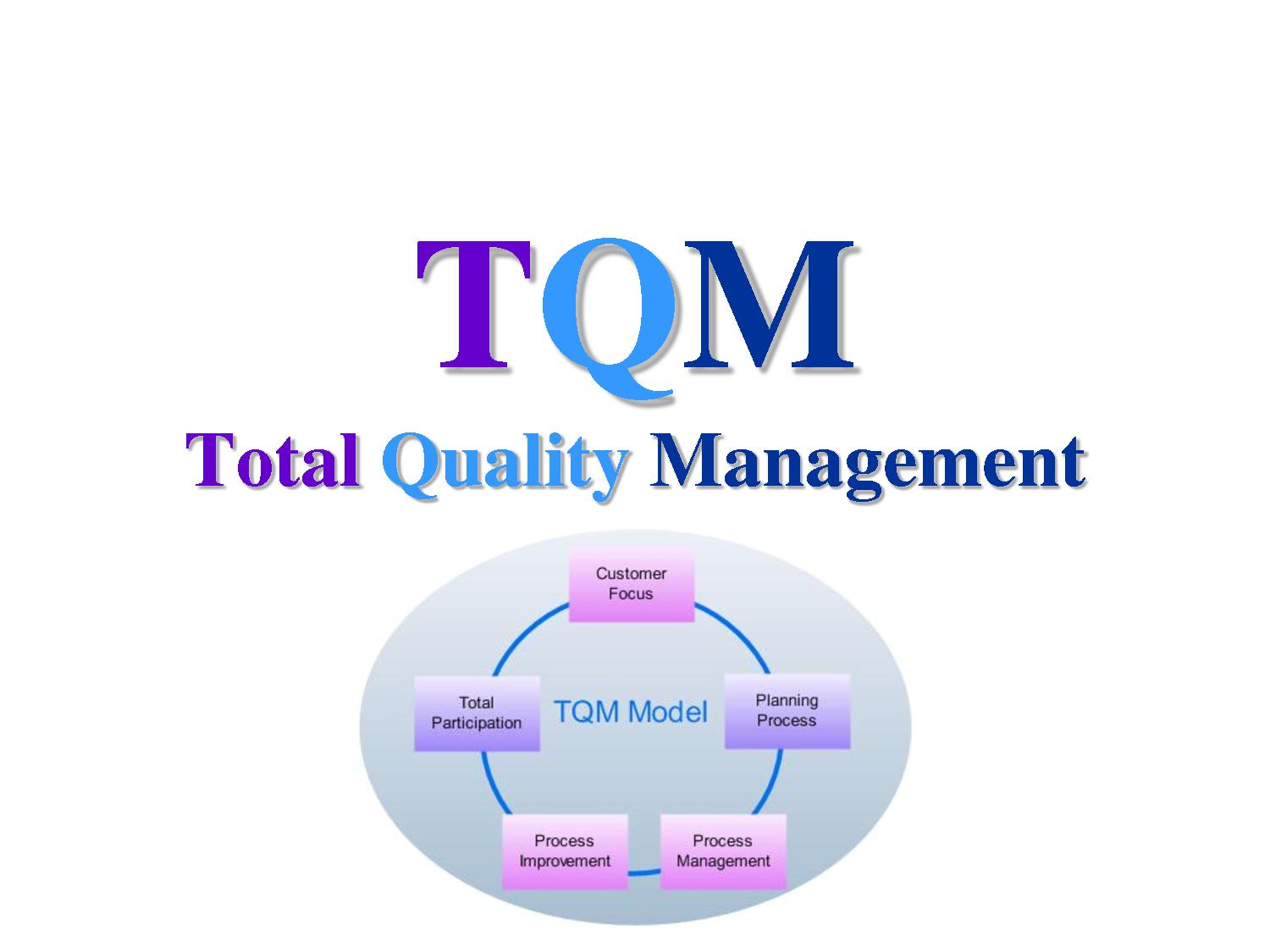
TQM can be defined as the management of initiatives and procedures that are aimed at achieving the delivery of quality products and services.
A number of key principles can be identified in defining TQM, including:
Executive Management – Top management should act as the main driver for TQM and create an environment that ensures its success.
Training – Employees should receive regular training on the methods and concepts of quality.
Customer Focus – Improvements in quality should improve customer satisfaction.
Decision Making – Quality decisions should be made based on measurements.
Methodology and Tools – Use of appropriate methodology and tools ensures that non-conformances are identified, measured and responded to consistently.
Continuous Improvement – Companies should continuously work towards improving manufacturing and quality procedures.
Company Culture – The culture of the company should aim at developing employees ability to work together to improve quality.
Employee Involvement – Employees should be encouraged to be pro-active in identifying and addressing quality related problems.
Why register your company to ISO 9001 .
Benefits of ISO 9001

ISO 9001:2008 aims to provide a practical and workable Quality Management System for improving and monitoring all areas of your business.
Achieving the standard is not about establishing a set of procedures that are complicated and difficult to manage. With the right support and the knowledge of your employees, you will end up with a system that will improve all areas of your organisation.
Implementing an effective and robust Quality Management System (QMS) will help you to focus on the important areas of your business and improve efficiency. The management processes that are established throughout your business will provide a sound foundation, leading to increased productivity and profit. This in turn will improve your customer acquisition and retention.
Some of the main benefits include:
- Suitable for both small and large organizations
- Better internal management
- Less wastage
- Increase in efficiency, productivity and profit
- Improved customer retention and acquisition
- Consistent outcomes, measured and monitored
- Globally recognised standard
- Compatible with other ISO standards
A valid ISO 9001:2008 certificate will be a prerequisite for some of your customers and a “nice to have” for others, when they are considering suppliers.
It gives your customers confidence that you are working to standards and procedures that will provide them with a high standard of customer service.
Benefits to your customers:
The ISO 9001:2008 standard is recognised worldwide and your customers will understand the benefits of working with companies that are ISO 9001:2008 certified. In fact, some of your customers will only do business with certified companies because it gives them assurance that you management systems are constantly assessed and approved.
They will know from experience that working with ISO 9001:2008 certified companies provides many advantages:
Minimizes mistakes:
Improves reporting and communications
Better quality products and service
More reliable production scheduling and delivery
Standards maintained by annual assessments
Conducting Audits: Science or Art:
contact: kris@themanagementsystems.com
Conducting Audits can be a Science but Meaningful Audits is an Art:
- Identifying missing elements and obvious
 noncompliance/nonconformances is easy,
 - Identifying what is good and/or done right is necessary but difficult,
- Identifying nonconformances to the intent of the standards or ineffective processes and activities is difficult in a working environment,
- Separating the trivial (observations and findings) from the Important takes judgement and experience,
- Lecturing about audit conduct and policy is easy,
- Asking the right questions is harder,
- Getting people to talk and listening to what they have to say can be difficult,
- Establishing credibility (audit has value) is an art, it must be earned,
- Maintaining control of the audit without turning off communications takes leadership,
- Separating fact from fancy takes experience; reliance on objective evidence,
- Making recommendations to resolve findings & observations is not good audit practice: – Lack of familiarity with the process and practice – Lose objectivity and become part of the problem,
- Making suggestions that would stimulate resolution is recommended, where necessary.
Choosing Vendors
 contact: kris@themanagementsystems.com
Your vendors have as much interest in your company’s success as you do.
When you make a lot of sales, they make a lot of sales; when you get paid, they get paid. Having reliable and trustworthy vendors can help your business succeed, just as dealing with unreliable or shady firms can cause major setbacks.
Start by asking around; other business owners in your area can be a great source of information. Once you’ve got a list of names, call your local Better Business Bureau to find out whether any complaints have been filed against any of the vendors on your list. You can visit vendor Web sites and even tour their physical locations. You can ask for customer testimonials and for product samples as well. The key is to get as much information as possible before you make a large monetary commitment to a vendor you don’t know.
As you begin to choose vendors, particularly those who will stock your inventory, try to think of them as business partners. You want to choose the ones with whom your company can develop a long-term, mutually profitable relationship, and that relationship starts with your first request for a price quote. Don’t be afraid to ask vendors for quotes; they’re used to it and they probably expect it. After all, this is a major purchase, and it’s never wise to make a major purchase without shopping around — especially when you’re going to a vendor you’ve never dealt with before.
When you’re dealing with a new business and new vendors, make sure to get price quotes from at least two sources for any purchase over $150. If your order will be a lot more than that, consider getting at least three different quotes; more is even better.
If you’re having a hard time finding vendors, and an even harder time finding information about them, you can run your own test by placing a very small order, under $100 in total value. If that process goes well, take it up a notch and place a slightly larger order the next time. Once you feel comfortable with the vendor, you can place your full-blown orders without worry.
Getting Quotes
When you want to make a big purchase for your business, you need to know the total cost upfront. To get that information, you need to ask the people who sell whatever it is you want to buy. In order for that information to be fixed (as opposed to changeable), it’s best to get it in writing. When your company is buying a product, that information will come in the form of a quote; when it’s services you’re after, the quote is usually referred to as an estimate.
The best way to get a quote is to talk with a salesperson; quote requests that come by mail are often ignored. Phone contact is fine, especially after you’ve begun to build a relationship with that vendor or salesman. For your first time out, though, a face-to-face meeting could prove more fruitful, especially if you’re spending a significant sum. Even though salesmen themselves are seldom involved in setting company pricing policy, they often have some leeway when it comes to closing a deal. When you establish a personal connection with a salesman, he’ll work harder with you and for you; after all, making a sale to you is his bread and butter. Flexible areas often include lower unit pricing when you buy in bulk, and better credit terms.
Hitting it off with the salesman is a great start toward developing a good relationship with a vendor. However, don’t stop after getting a single quote just because you like the first salesman you meet with. Another vendor may offer better pricing, better terms, better merchandise, and maybe a salesman that you’ll like even better.
Avoid These Vendors
There are some vendors that you should avoid. If you run across a vendor with one (or more) of the following characteristics, run in another direction:
Accepts cash only
Asks for checks made out to cash
Won’t send a brochure or catalog
Won’t give you a price quote or estimate in writing
Dirty, disorganized stockroom
No warehouse or storage facility
If one (or more) of these factors is the norm in your industry, and the vendor in question has gotten high marks from a reliable source, it’s probably safe to keep him on your list. However, if it’s the vendor telling you this is normal practice, and you can’t verify that with anyone else, look for a different vendor.
http://www.netplaces.com/accounting/controlling-purchase-costs/choose-your-vendors-wisely.htm
 Source Management